The Seduction of an Analogy
Every age prefers to read its novelties in the vocabulary of the last. The twentieth century was written in oil. Its wars, alliances and fortunes followed the pipeline and the tanker, and Daniel Yergin could call his history of the century’s defining commodity, without exaggeration, The Prize. It is unsurprising, then, that lithium, the soft silvery metal now sealed inside every electric vehicle and grid battery, should be crowned the oil of the twenty-first century. The phrase has the merit of brevity. It has the defect of being largely wrong.
Oil is a flow. It is pumped, shipped and burnt, and the barrel consumed today must be replaced tomorrow. Lithium is a stock. Once refined and sealed inside a cell, it can serve for a decade and then be recovered. Oil trades in a deep, liquid market that a producers’ cartel has policed for half a century. Lithium trades in a thin, opaque market with no cartel at all, and its prices have behaved accordingly. In China, battery-grade lithium carbonate rose roughly fourteenfold between mid-2020 and November 2022, touching about 600,000 yuan a tonne. Within two years it had shed more than four-fifths of that value. Australian mines were mothballed, Chinese converters cut output, and a commodity proclaimed scarce spent much of 2024 and 2025 in glut.
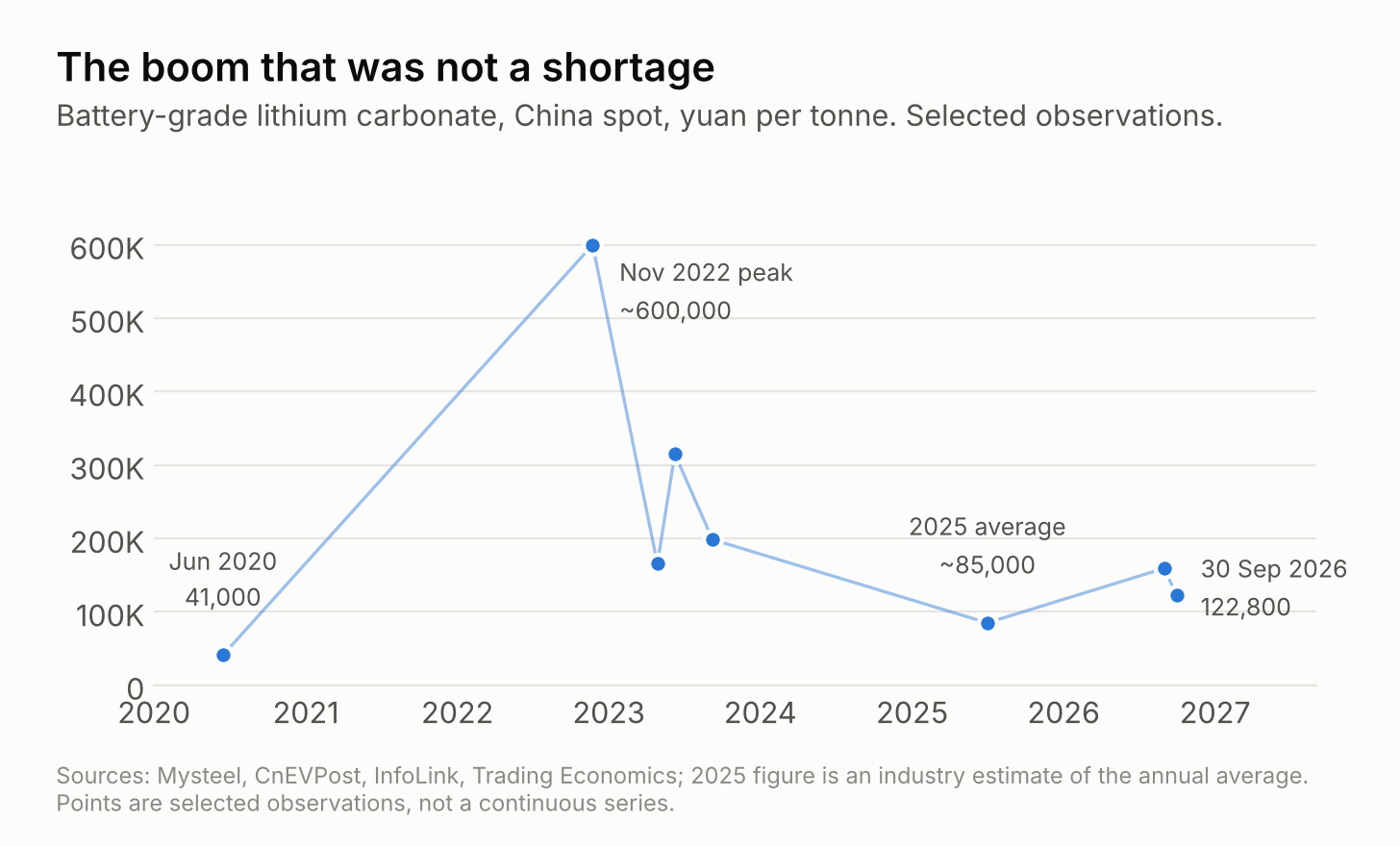
The glut did not mean the demand story was false. Lithium consumption grew by nearly 30 per cent in 2024 alone, and the International Energy Agency still expects the market to tip into deficit before the decade is out. Prices duly recovered through 2026, with Chinese futures briefly clearing 200,000 yuan in May before easing again. What the cycle exposed was something else. The metal was never truly scarce. Converting it was. A commodity that can swing from famine to feast and back within four years is not a reliable instrument of coercion for anyone who merely owns it in the ground.
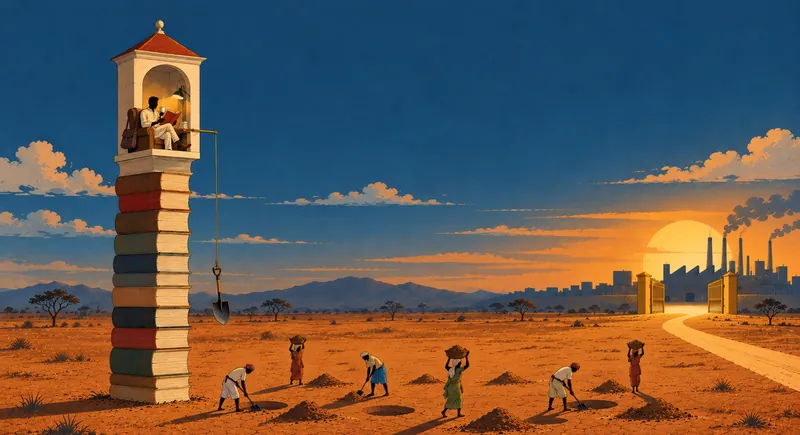
Yet the analogy persists, and for one sound reason. Lithium, like oil before it, has become a currency of state power. The error lies in locating that power in the ground. Years of work across India, China and Southeast Asia have persuaded me that the decisive leverage in this contest sits elsewhere: in the refinery, the cathode plant, the patent office and the standards committee. Whoever owns the ore holds an option. Whoever converts it holds the market.
That distinction frames everything that follows. China grasped it two decades ago. India has grasped it recently and acted on it slowly. Southeast Asia, courted from every direction, is discovering that being wanted is not the same as being in command.
The Refinery Republic
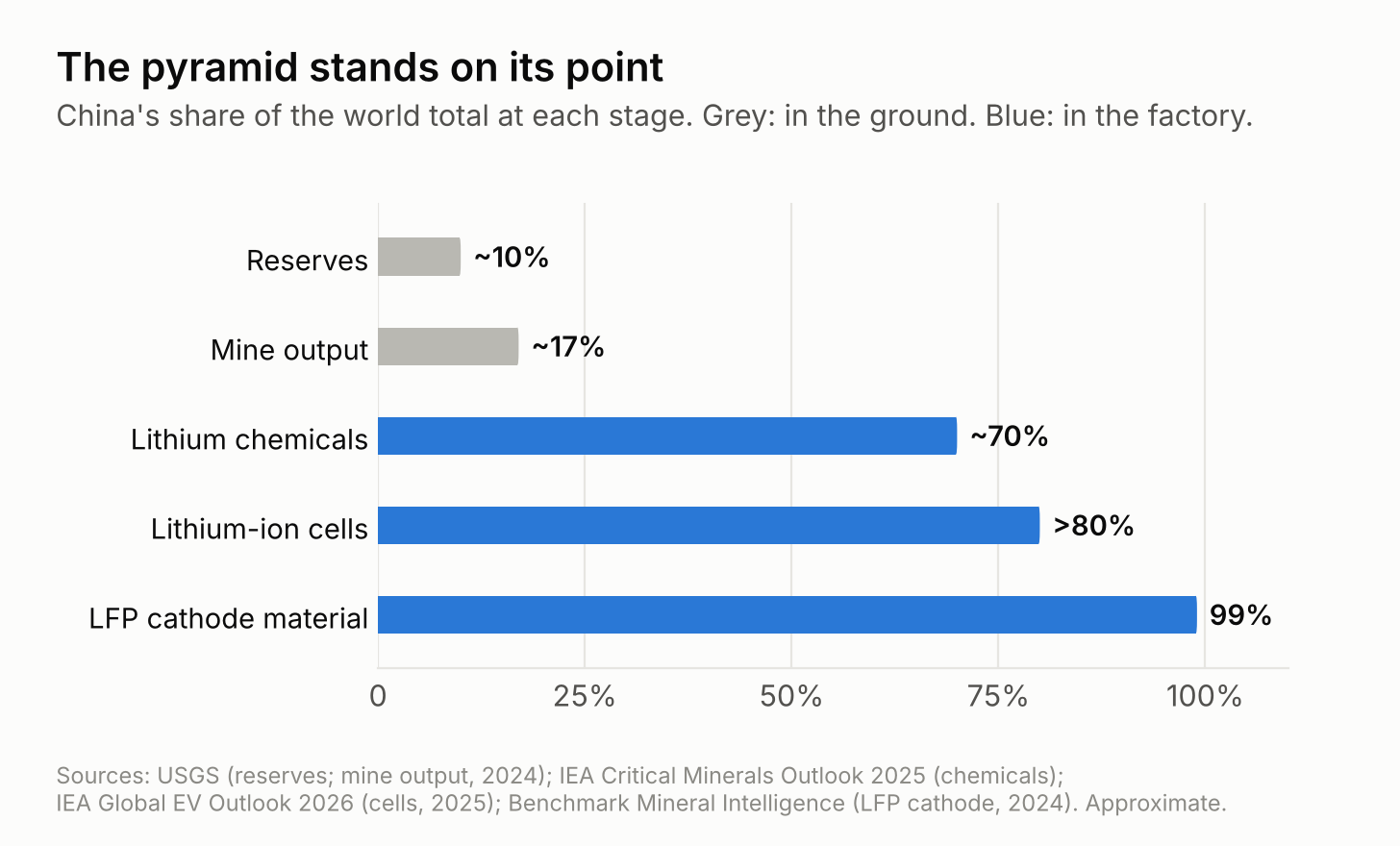
China’s place in the lithium economy is a study in disproportion. It holds roughly a tenth of the world’s reserves on United States Geological Survey estimates, and mines perhaps a sixth of global output. Yet it produces about 70 per cent of the world’s lithium chemicals, by both location and ownership, according to the International Energy Agency. It manufactured well over 80 per cent of the world’s lithium-ion cells in 2025. Benchmark Mineral Intelligence puts its share of lithium iron phosphate cathode output in 2024 at 99 per cent. The pyramid stands on its point, and the point rests in China.
None of this was accidental. The Made in China 2025 programme, launched in 2015, designated new energy vehicles and advanced batteries as strategic industries. State banks extended credit, provincial governments cleared land for battery parks, and firms were encouraged to secure feedstock abroad. Ganfeng Lithium took stakes in Argentina’s Cauchari-Olaroz project and Australia’s Mount Marion mine. Tianqi Lithium acquired a substantial holding in Chile’s SQM and built conversion capacity in Sichuan. The pattern never varied. Where China could not own the deposit, it would own the next step.
The coherence of the system is its most arresting feature. Working in and around the industrial ecosystems of Shenzhen and Shanghai, I was repeatedly struck by how little was left to chance: municipal backing for technology parks, patient credit from state lenders, and a planning culture that treats critical minerals as instruments of national security rather than items on a commodity exchange. Western observers tend to call this subsidy. It is more accurately called sequencing.
Paradoxically, China’s dominance rests on dependence. Its converters import more than half their feedstock, much of it Australian spodumene and, increasingly, African concentrate. Beijing’s response has been to guard what others cannot easily copy. In July 2025 the Ministry of Commerce placed lithium refining methods, brine extraction techniques and phosphate cathode technologies on its list of restricted exports. In October it announced licensing controls on high-performance batteries, graphite anode materials and the machines that make them, then suspended those controls for a year under its understanding with Washington. The suspension lapses on 10 November 2026. The world’s battery supply chain, in other words, currently runs on a reprieve.
The limits of the Chinese model are no longer hypothetical. Chinese-owned operations in Zimbabwe and the Democratic Republic of Congo face sustained scrutiny over labour practices, water use and opacity. At home, environmental enforcement has begun to bite, most visibly in the revocation in 2026 of the environmental approval for CATL’s Jianxiawo lepidolite mine in Yichun. Excess is its own hazard. Global cell manufacturing capacity reached about 3.3 terawatt-hours in 2024, more than triple demand, and most of it sits in China. Dominance purchased at such scale breeds price wars at home and trade barriers abroad.
Here lies the most uncomfortable fact in the entire debate. China’s excess is also the world’s discount. Battery prices fell again in 2025, and more than 70 per cent of electric vehicles built outside China now rely on Chinese batteries or components, according to the IEA. The cheap cell that makes an electric scooter affordable in Pune or a solar-plus-storage project viable in Mindanao is, very often, the product of the concentration that capitals across the democratic world profess to fear. Every tariff raised against Chinese batteries is, at the margin, a tax on decarbonisation. Policymakers rarely say this aloud. They should, because a strategy that pretends the trade-off away will be ambushed by it.
The West’s Belated Arithmetic
Washington and Brussels have answered with statute. The Inflation Reduction Act of 2022 tied America’s consumer tax credit for electric vehicles to sourcing rules that excluded batteries linked to “foreign entities of concern”, a category universally read as China. The European Union’s Critical Raw Materials Act set the benchmark that no single third country should supply more than 65 per cent of any strategic raw material at any stage of processing. Europe has backed lithium ventures in Portugal, Serbia and Finland, and Western carmakers have courted suppliers in Australia, Canada and Chile.
The record is chastening. The IEA found that refining grew more concentrated, not less, between 2020 and 2024: across the key battery minerals, the average share of the top three refining nations rose from about 82 to 86 per cent. Battery manufacturing in Europe and the United States still costs up to half as much again as in China. And American policy has proved less durable than American rhetoric. The One Big Beautiful Bill Act, signed in July 2025, terminated the consumer clean vehicle credit for vehicles acquired after 30 September that year. The sourcing rules meant to redraw the supply chain lost most of their force along with the subsidy that carried them.
The lesson is uncomfortable. A statute can be drafted in a session; a refinery takes the better part of a decade. When Winston Churchill moved the Royal Navy from Welsh coal to Persian oil, he told the House of Commons in 1913 that security of supply lay “in variety and variety alone.” The West has rediscovered his maxim. It has yet to finance it.
Producer states, meanwhile, have drawn their own conclusions. Zimbabwe banned raw lithium ore exports in 2022 and will prohibit concentrate exports from January 2027. Resource nationalism, once regarded as an Indonesian eccentricity, is becoming the rule. For late movers such as India and the ASEAN states, this churn opens a narrow passage: not to rival China’s scale, but to occupy the gaps where geology, trust and policy coincide.
India: The Distance Between Announcement and Assembly Line
India came late to the lithium question and arrived with a headline. In February 2023 the Geological Survey of India announced 5.9 million tonnes of inferred lithium resources in the Reasi district of Jammu and Kashmir. The figure travelled fast and was widely misread. It described ore, not contained lithium, at the G3 stage, the most preliminary grade of exploration. When the Salal-Haimna block went to auction, it failed twice. The first attempt drew too few qualified bidders; the second, in 2024, drew none. Prospective investors cited thin geological data and a block too small for modern exploration methods. India’s first successful lithium auction came instead at Katghora in Chhattisgarh in June 2024.
The stakes are considerable. India imports virtually all its lithium, the great bulk of it from China and Hong Kong. It has been the world’s third-largest automobile market since overtaking Japan in 2022, which turns battery supply from an industrial aspiration into a strategic exposure. Every flare-up on the Himalayan frontier sharpens the point.
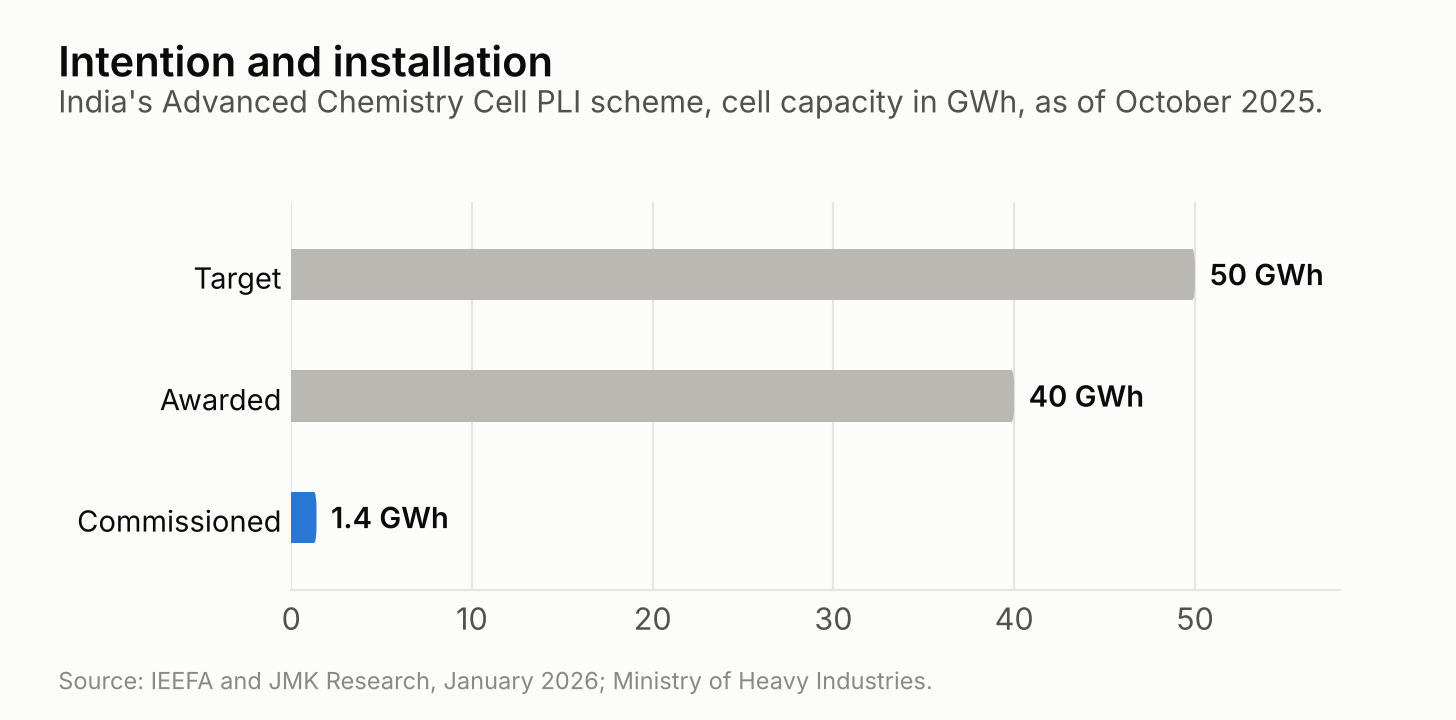
New Delhi’s answer has been a layered strategy. The Production-Linked Incentive scheme for Advanced Chemistry Cells, approved in 2021 with an outlay of ₹18,100 crore, set out to create 50 gigawatt-hours of domestic cell capacity. Abroad, Khanij Bidesh India Ltd (KABIL), a joint venture of NALCO, Hindustan Copper and MECL, signed India’s first overseas lithium exploration agreement in January 2024, securing rights to five brine blocks in Argentina’s Catamarca province. The National Critical Mineral Mission, launched in 2025, extends the effort across exploration, processing, recycling and stockpiling. Private capital has followed: Lohum opened what it calls India’s first battery-grade lithium refinery in 2025, with an annual capacity of 1,000 tonnes.
The ambition is genuine. The execution has not kept pace. An assessment by IEEFA and JMK Research found that by October 2025 only 1.4 gigawatt-hours of the scheme’s 50 gigawatt-hour target had been commissioned, all of it by Ola Electric, and that no incentive had yet been disbursed. Against a projection of about a million jobs, the scheme had created 1,118. Land has been acquired for the 40 gigawatt-hours awarded; the factories, for the most part, remain to be built. In Indian industrial policy, the press release has an inveterate habit of arriving years before the assembly line.
Three structural constraints explain the gap. The first is the missing midstream. A 1,000-tonne refinery is a welcome beginning, but by global standards it is a pilot, and without conversion at scale Indian lithium, wherever it is mined, must still pass through foreign hands. The second is fragmentation. China’s champions, CATL and BYD, span mining, refining, cells and vehicles. India’s firms, from Tata Motors and Mahindra to Ola, are strong in assembly and dependent on others for cathodes, anodes, electrolytes and cell design. The third is institutional. Indian mining carries a long history of community conflict and protracted clearances, and the traceability and due-diligence norms now demanded by Western buyers will require reform, not mere compliance.
Beneath all three sits a dilemma New Delhi prefers not to name. The know-how India needs is concentrated, overwhelmingly, in Chinese firms. Since 2020, investment from countries sharing a land border with India has required government approval, and Chinese battery and automotive capital has been kept at arm’s length. The instinct is understandable after Galwan. Its cost is real. India is attempting to build a battery industry while declining the one partner that knows how to build it cheaply, and the Japanese, Korean and European alternatives are slower, costlier and themselves retreating from parts of the business. Security and speed pull in opposite directions. India will have to decide, sector by sector, which it values more, and accept the price of the answer.
India’s advantages are real, if of a different order. Its domestic market can anchor demand at a scale few nations can match. Its engineering talent is well suited to battery management systems, diagnostics and energy analytics, the layers where hardware acquires intelligence. Its storage ambitions are widening, with a separate tender for 10 gigawatt-hours of grid-scale cell capacity under way in 2026. Having worked with industrial clusters across the country, I am convinced that India’s decisive opportunity lies in integration: binding mineral sourcing to vehicle policy, renewable targets, grid planning and urban transport, so that one ministry’s incentive becomes another’s demand signal. The window is open. It will not stay open, and it rewards speed more than size.
Southeast Asia: Swing Region or Relay Station?
Southeast Asia has neither the brines of the Andes nor the refining depth of China. Its claim rests on other assets: nickel, cobalt and copper; a skilled manufacturing workforce; a dense web of trade agreements; and a geopolitical posture that lets it receive capital from Beijing, Tokyo, Seoul, Washington and Brussels at once. It is routinely called the swing region of the battery economy. The label deserves scrutiny.
Indonesia is the boldest case. In January 2020 it banned the export of raw nickel ore, a measure the European Union contested at the World Trade Organization. On its own terms, the policy succeeded. The value of Indonesia’s nickel exports rose from about $3 billion to $30 billion within two years as smelters multiplied in the industrial parks of Morowali and Weda Bay. The country now supplies roughly 60 per cent of the world’s nickel.
The builders, however, were overwhelmingly Chinese. Chinese companies control about three-quarters of Indonesia’s nickel smelting capacity, according to the Center for Advanced Defense Studies. When LG Energy Solution withdrew from Indonesia’s flagship integrated battery venture in April 2025, citing market conditions, its place passed to China’s Huayou Cobalt. Two months later President Prabowo Subianto broke ground on a CATL battery plant in West Java, a venture with the state-owned Indonesia Battery Corporation planned at 15 gigawatt-hours. Indonesia has achieved value addition. It has not achieved diversification. To a Western buyer seeking escape from Chinese concentration, Indonesian nickel often presents that same concentration under a different postmark.
Chemistry compounds the difficulty. Indonesia’s wager rests on nickel-rich cathodes, yet lithium iron phosphate, which uses no nickel at all, accounted for more than 55 per cent of electric vehicle batteries deployed worldwide in 2025 and more than 90 per cent of grid storage. The Hyundai and LG cell plant in West Java exported almost its entire 2024 output, as Hyundai’s share of Indonesia’s own electric vehicle market collapsed before Chinese rivals. A nation can win the battle for the smelter and still find that the market has moved to another cathode.
There is a further irony, and it is environmental. Much of Indonesia’s nickel boom runs on captive coal power built inside the industrial parks themselves, and the forests of Halmahera and Sulawesi have paid a visible price. Clean batteries, in other words, are being assembled from metal processed with one of the dirtiest fuels available. As Europe’s carbon footprint rules for batteries come into force, that embedded coal will cease to be a local controversy and become a commercial liability. The green transition, it turns out, has its own resource curse.
Vietnam has chosen a different road, trading on manufacturing competence and diplomatic dexterity rather than geology. It has become a favoured destination for “China plus one” diversification in electronics, pack assembly and components, buttressed by the CPTPP, RCEP and its free trade agreement with the European Union. VinFast, its national champion, carried the country’s ambitions abroad, though its $4 billion North Carolina plant has been postponed to 2028, a reminder that overseas expansion in this industry is easier to announce than to finance.
The Philippines offers a cautionary tale of another kind. It is the world’s largest exporter of nickel ore, shipping about 45 million wet tonnes in 2024, close to four-fifths of it to China. In February 2025 the Senate passed a bill to ban raw ore exports by 2030, explicitly modelled on Indonesia. By June the provision had been struck out in the bicameral conference after determined opposition from the mining industry. Its downstream hopes now rest on the existing high-pressure acid leach plants at Coral Bay and Taganito and on investment pledges yet to mature. One senator called the country “a rich country pretending to be poor.” It has yet to decide to stop pretending.
Elsewhere, Thailand has set a target for zero-emission vehicles to reach 30 per cent of domestic production by 2030, drawing Chinese and Japanese battery investment to its Eastern Economic Corridor. Malaysia offers a mature semiconductor base and logistical depth that could make it a regional platform for assembly and recycling.
The region’s leverage is therefore real but conditional. Its governments have proved adept at welcoming rival capital while guarding national discretion; I have watched this balancing act at close quarters across several ASEAN economies. The European Union’s Battery Regulation, in force since 2023, is phasing in carbon footprint declarations and due-diligence obligations that will reward early adopters of traceability. Countries that align with such standards will gain preferred access to demanding markets. Those that do not will remain relay stations, transmitting Chinese capacity under local flags. Southeast Asia is a swing region only if it chooses to swing.
Beyond the Mine: Chemistry, Circularity and Standards
If the preceding sections share one lesson, it is that extraction is the least defensible link in the chain. Converting spodumene or brine into battery-grade hydroxide or carbonate is capital-intensive, technically exacting and environmentally demanding. Few countries do it at scale; fewer still do it cleanly. China’s July 2025 restrictions were aimed precisely here, at the know-how that turns rock into chemicals. Processing is power, and Beijing has now said so in the language of export law.
For India and the ASEAN states, the implication is plain. Mining rights abroad are necessary but insufficient. The priority must be onshore conversion, built through joint ventures with experienced operators from Japan, South Korea, Australia and Europe, and housed in processing parks with predictable clearances, reliable power and port access. India’s mineral mission envisages four regional processing parks; their execution will matter far more than their announcement. Friendshoring offers capital and markets to countries that can promise regulatory stability and political trust. It offers nothing to those that promise only intent. Strategic stockpiles, which India’s mission also contemplates, can buy time against a sudden cut-off. They cannot buy capability, and a reserve of imported carbonate is no substitute for the plant that makes it.
Recycling is the second frontier. Because lithium is a stock rather than a flow, every battery sold today is tomorrow’s ore body. The IEA estimates that recycled minerals could meet up to 15 per cent of demand by 2035. Here too China has moved first, accounting for about two-thirds of the growth in global battery recycling capacity since 2020. For the Philippines and Malaysia, rich in electronic waste and poor in lithium, urban mining offers domestic supply without the geopolitical exposure of a mine. India’s recycling incentives, and firms such as Attero and Lohum, sketch the outline of such an ecosystem. Extended producer responsibility, binding recovery targets and green finance for circular enterprises would give it substance.
The third frontier is chemistry itself, and it harbours an irony worth savouring. The most credible challenge to lithium’s centrality is the sodium-ion battery, which replaces a scarce metal with one drawn from common salt. CATL’s Naxtra sodium-ion cells reach 175 watt-hours per kilogram, close to lithium iron phosphate, and entered passenger cars with Changan in 2026. The company has also signed a 60 gigawatt-hour sodium-ion supply agreement for grid storage. The escape route from lithium dependence, it transpires, also runs through Fujian. Technological sovereignty will matter as much as mineral sovereignty, and nations that neglect research, intellectual property and scientific talent risk securing yesterday’s input for tomorrow’s battery.
Standards complete the picture. Traceability, carbon accounting and due diligence are fast becoming conditions of market entry. Those who write and certify these rules will shape the trade as surely as those who mine and refine.
A Cartography Still Being Drawn
Lithium is not oil. It is something subtler and, for that reason, harder to command. Its strategic value lies less in the metal than in the systems it organises: refineries and cathode lines, recycling plants and patent portfolios, grid storage and the regulations that certify all of them. The geopolitics of the last century asked who held the wells. The geopolitics of this one asks who holds the process.
On that measure, China’s lead is formidable and, for this decade at least, durable. The West has legislated faster than it has built. India has announced faster than it has commissioned. Southeast Asia has attracted capital faster than it has acquired control. Each judgement is severe, and each could be revised within a few years by a handful of well-executed projects. None of those projects is assured.
What is assured is that the contest will not be settled by reserves. The countries that prevail will be those that match resource access with conversion capacity, technological depth with credible governance, and industrial ambition with the patience to carry a refinery through its first unprofitable years. Asia has the market, the minerals and much of the talent. Whether it has the coherence is the question this decade will answer.
China’s suspended battery export controls fall due for review on 10 November, within weeks of this writing. It is a fitting emblem of the moment: a supply chain on which the energy transition depends, held open by a reprieve that one government grants and may withdraw. Churchill’s counsel has lost none of its force. Security lies in variety. Variety, however, is not found underground. It has to be built.
Sources: International Energy Agency, Global Critical Minerals Outlook 2025 and Global EV Outlook 2026; US Geological Survey, Mineral Commodity Summaries 2025 and 2026; Benchmark Mineral Intelligence; IEEFA and JMK Research (January 2026); Ministry of Mines, Government of India; Ministry of Heavy Industries, Government of India; China Ministry of Commerce; Center for Advanced Defense Studies; Argus Media; Mysteel and CnEVPost price data.